Computer Stuck on Blue Screen
If your computer is stuck on a blue screen, hold the power button for about 10 seconds, start it again, and let Windows open the recovery menu. From there use Startup Repair, Uninstall Updates or Safe Mode to undo the last update or driver. Microsoft's Troubleshoot blue screen errors page and its bug check code reference explain each stop code.
Checked November 3, 2026 against the manufacturer's own pages.
The short version
What to install and where it comes from. Every link goes to the manufacturer or Microsoft, never to a copy.
Official files only, nothing bundled
Step by step
Force the PC off and unplug extras
If the screen has sat at 100% or frozen for several minutes, hold the power button until the PC turns off. Unplug USB drives, docks, printers and any device you added recently, then start it again. Microsoft lists removing new hardware as the first check.
Get into the recovery menu
If Windows fails to start several times in a row, it opens the Windows Recovery Environment on its own. You can force it by interrupting startup with the power button two times. If you can still reach the desktop, go to Settings, System, Recovery, Advanced startup, Restart now (Windows 10: Settings, Update & Security, Recovery).
Run Startup Repair
In the recovery menu choose Troubleshoot, Advanced options, Startup Repair. It looks for problems that stop Windows from loading and fixes what it can. Let it finish, even if it takes a while.
Remove the last update
If the blue screens began right after Windows Update, choose Troubleshoot, Advanced options, Uninstall Updates. Remove the latest quality update first. Try the feature update option only if a big version upgrade came just before the crashes.
Boot into Safe Mode and undo the driver
Choose Troubleshoot, Advanced options, Startup Settings, Restart, then press 4 for Safe Mode or 5 for Safe Mode with Networking. Open Device Manager, find the device whose driver you changed, and use Roll Back Driver or Uninstall device.
Restore an earlier point
Still stuck? Pick System Restore in the same Advanced options menu and choose a restore point dated before the first crash. Windows creates restore points when you install a driver, an app or an update.
Read the stop code and fix the cause
Once Windows starts, write down the stop code shown on the crash screen and look it up in the table below. Then install the driver or firmware update for the part it points to, from Windows Update or your PC maker first.
Faster option: update drivers automatically
The steps above fix this one device. If several drivers are old, a driver updater finds and installs them all in one go, and backs up the current ones first.
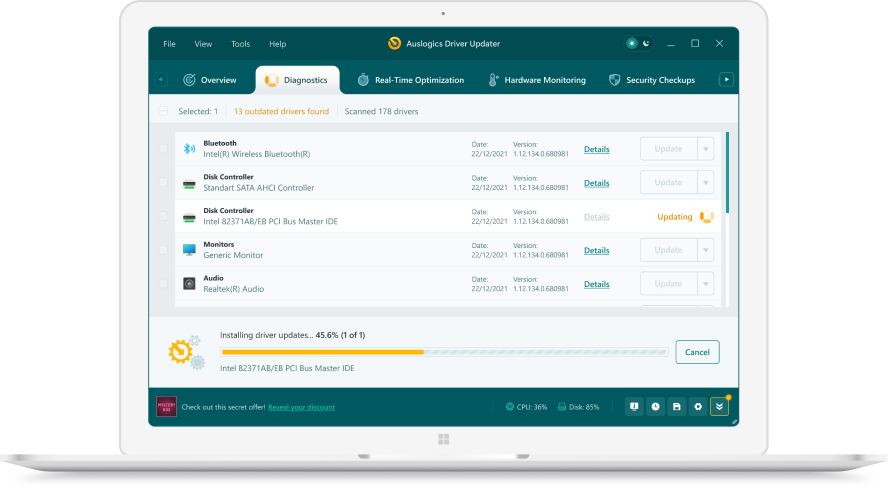 1. Scan. Download the free version and run a scan.
 2. Review. See each old or missing driver with its newer version.
 3. Update. Update one driver free, or all at once with Pro.

Update this driver automatically
Finds and updates this driver and every other outdated driver on your PC.
Auslogics Driver Updater · Free scan · Windows 11, 10, 8, 7 · Backup before every change
Which stop codes point to a driver?
Every stop screen shows a name in capital letters, such as PAGE_FAULT_IN_NONPAGED_AREA, and Microsoft’s reference gives each name a hex bug check value. The codes below are the ones most often tied to drivers, storage or memory. Pick yours for the exact fix.
| Stop code | Bug check value | What it usually points to |
|---|---|---|
| KMODE_EXCEPTION_NOT_HANDLED | 0x0000001E | A kernel driver error nothing caught |
| MEMORY_MANAGEMENT | 0x0000001A | RAM or a driver corrupting memory |
| PAGE_FAULT_IN_NONPAGED_AREA | 0x00000050 | Bad memory address, driver, antivirus or disk |
| INACCESSIBLE_BOOT_DEVICE | 0x0000007B | Boot disk or storage controller driver |
| SYSTEM_THREAD_EXCEPTION_NOT_HANDLED | 0x0000007E | A system thread crashed inside a driver |
| DRIVER_POWER_STATE_FAILURE | 0x0000009F | A driver failing during sleep or wake |
| CLOCK_WATCHDOG_TIMEOUT | 0x00000101 | A processor core stopped responding |
| DPC_WATCHDOG_VIOLATION | 0x00000133 | A driver running far too long |
How do I find the driver behind the crash?
Look at the bottom of the stop screen first. When Windows can tell which module was running, it prints a file name ending in .sys next to the code. That name is your best lead: nvlddmkm.sys belongs to NVIDIA graphics, igdkmd64.sys to Intel graphics, and iaStorA.sys to Intel storage, for example.
If the screen vanished too fast, check Event Viewer. Microsoft notes that the bug check event in the System log lists all four parameters. The Device Manager list helps too: a yellow warning icon on a device often marks the same part that crashed.
Should I read the dump file myself?
You can, but you rarely need to. The small dumps in C:\Windows\Minidump open in WinDbg, Microsoft’s free debugger, and its !analyze -v command names the likely module. For most people, the name on the screen plus the steps on the matching page above is enough. If the dump blames ntoskrnl.exe, that is the Windows kernel reporting the crash, not usually the cause.
Questions
How long should I wait before forcing a restart?
If the percentage counter on the crash screen has not moved for several minutes, or the screen shows no counter at all, Windows is not going to recover by itself. Hold the power button to turn it off.
Will I lose my files with Startup Repair or System Restore?
Neither tool deletes personal files. System Restore removes apps, drivers and updates installed after the restore point you pick, so you may need to reinstall some programs.
Why is my blue screen black on Windows 11?
Microsoft's support page shows a black stop screen for Windows 11 version 24H2 and later. Older versions, including Windows 10 and Windows 11 23H2, still show the blue one. The stop code works the same way on both.
Is a blue screen usually hardware or a driver?
Microsoft's own crash analysis puts about 70% of stop errors down to third-party driver code and about 10% to hardware faults. Start with drivers and updates, then test memory and disks if the code points that way.
Where do I find the stop code after the PC restarts?
Open Event Viewer, Windows Logs, System and look for the bug check event at the time of the crash. Its details list the code and four parameters. Small crash files are also saved in C:\Windows\Minidump.