Fix KMODE_EXCEPTION_NOT_HANDLED
KMODE_EXCEPTION_NOT_HANDLED (bug check 0x0000001E) means a kernel-mode program raised an exception that no error handler caught. Disable, roll back or update the driver named on the stop screen, and remove any driver or service added just before the crashes. Microsoft's bug check 0x1E reference lists the exception codes and the checks to run.
Checked November 3, 2026 against the manufacturer's own pages.
The short version
What to install and where it comes from. Every link goes to the manufacturer or Microsoft, never to a copy.
Official files only, nothing bundled
Step by step
Note the file name on the stop screen
KMODE_EXCEPTION_NOT_HANDLED often prints a module such as nvlddmkm.sys or a network driver next to the code. Take a photo of the screen so you have the exact name. If nothing is printed, move to the Event Viewer step.
Start in Safe Mode if Windows will not load
Microsoft says that when 0x1E hits during startup on an NTFS system drive, Safe Mode lets you disable the driver in Device Manager. Hold Shift while you select Restart, then Troubleshoot, Advanced options, Startup Settings, Restart, and press 4.
Disable or roll back the named driver
In Device Manager, find the device that owns the file. Open it, go to the Driver tab and choose Roll Back Driver if a recent update caused the crashes, or Disable device to test without it.
Remove what you added last
Uninstall drivers, VPN clients, antivirus tools or other services that arrived shortly before the first crash. Microsoft's advice for 0x1E is to disable or remove anything recently added.
Install the current driver the right way
Run Windows Update, including Optional updates, Driver updates. Then check your PC maker's support page for the model. Go to the chip maker, such as NVIDIA, AMD or Intel, only when the PC maker has nothing newer.
Update the BIOS and test memory
Microsoft points to BIOS incompatibility as a possible cause, so ask your PC maker for a BIOS update. Then run the maker's hardware diagnostics, especially the memory test, as Microsoft suggests.
Faster option: update drivers automatically
The steps above fix this one device. If several drivers are old, a driver updater finds and installs them all in one go, and backs up the current ones first.
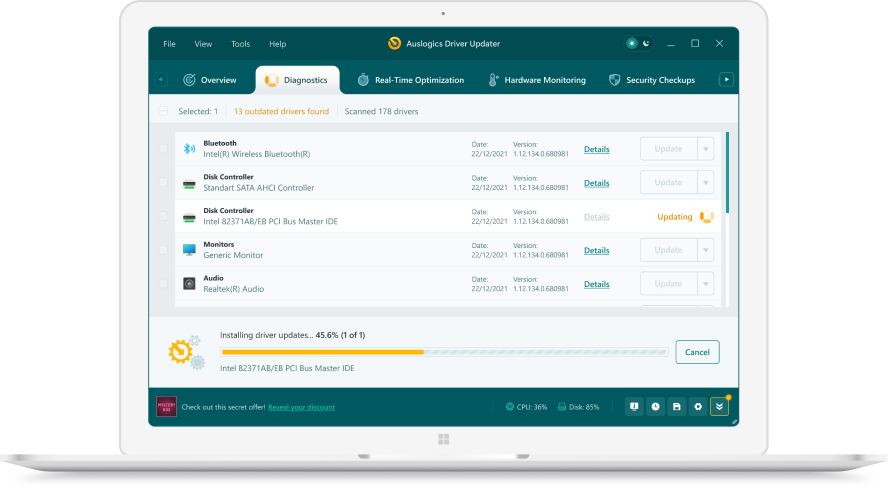 1. Scan. Download the free version and run a scan.
 2. Review. See each old or missing driver with its newer version.
 3. Update. Update one driver free, or all at once with Pro.

Update this driver automatically
Finds and updates this driver and every other outdated driver on your PC.
Auslogics Driver Updater · Free scan · Windows 11, 10, 8, 7 · Backup before every change
What does KMODE_EXCEPTION_NOT_HANDLED mean?
Code that runs in kernel mode, which includes nearly every hardware driver, is expected to deal with its own errors. When one of them raises an exception and nothing handles it, Windows halts with 0x1E. Microsoft describes it as a kernel-mode program generating an exception the error handler did not catch.
The first parameter tells you which exception it was. Microsoft lists three common ones: 0x80000002 for misaligned data, 0x80000003 for a breakpoint hit with no debugger attached, and 0xC0000005 for an access violation. The second parameter is the address where it happened, which a debugger maps to the driver at fault.
Which driver file is named in the error?
The file shown on screen tells you who to contact for an update. These are some files people commonly see with this code:
| File named | Belongs to | Where the update comes from |
|---|---|---|
| nvlddmkm.sys | NVIDIA graphics driver | PC maker, then nvidia.com |
| atikmpag.sys or amdkmdag.sys | AMD graphics driver | PC maker, then amd.com |
| igdkmd64.sys | Intel graphics driver | PC maker, then intel.com |
| ntoskrnl.exe | Windows kernel | Usually not the cause; read the dump |
Where to look if no file is shown
Open Event Viewer, then Windows Logs, System, and look for critical errors at the minute of the crash. Microsoft recommends this log for finding the device or driver behind 0x1E. A small dump is also saved in C:\Windows\Minidump, which WinDbg can open if you want the module name from the crash itself.
Questions
Is KMODE_EXCEPTION_NOT_HANDLED a hardware problem?
Usually it is a faulty driver or system service. Microsoft also lists BIOS incompatibilities, memory conflicts and IRQ conflicts, so a hardware or firmware cause is possible when updating drivers does not help.
Does KMODE_EXCEPTION_NOT_HANDLED happen on Windows 11 too?
Yes. The stop code and its meaning are the same on Windows 10 and Windows 11. On Windows 11 version 24H2 and later the crash screen is black instead of blue, but the code and file name appear in the same place.
What does 0xC0000005 mean with this error?
It is STATUS_ACCESS_VIOLATION: a driver tried to touch memory it should not. Microsoft notes that in this case parameter 4 of the bug check holds the address the driver tried to access.
It crashed right after installing Windows. What now?
Microsoft says 0x1E can appear after the first restart of Windows Setup, and a system BIOS incompatibility is one possible cause. Update the BIOS from your PC maker and run Setup again.