Fix Clock Watchdog Timeout
CLOCK_WATCHDOG_TIMEOUT (bug check 0x00000101) means a secondary processor core did not receive its expected clock interrupt in time because it was hung or deadlocked. Reset any CPU or memory overclock to default, then install the latest BIOS and chipset drivers from your PC maker. Microsoft's bug check 0x101 reference describes the cause.
Checked November 3, 2026 against the manufacturer's own pages.
The short version
What to install and where it comes from. Every link goes to the manufacturer or Microsoft, never to a copy.
Official files only, nothing bundled
Step by step
Return clocks and voltages to default
Enter the BIOS or UEFI setup and load optimized or factory defaults. This removes CPU overclocks, undervolts and memory profiles such as XMP or EXPO. Uninstall any tuning utility that changes clocks from inside Windows too.
Update the BIOS from your PC or board maker
Processor microcode fixes reach your PC through BIOS updates. Download the newest version for your exact model from the PC or motherboard maker's support page and follow its instructions. Keep a laptop on mains power while it runs.
Install chipset drivers
Get the chipset package for your model from the PC maker, or from Intel or AMD if the maker has none. Microsoft's stop error guidance lists current BIOS and firmware among its first checks.
Run Windows Update
Go to Settings, Windows Update, Check for updates, then install anything under Advanced options, Optional updates. Windows 10 users find it under Settings, Update & Security.
Check temperatures and cooling
Clean dust from fans and vents. On a desktop, make sure the CPU cooler is seated and its fan spins. A core that overheats or is starved of power can stop answering.
Run the maker's hardware diagnostics
Use the diagnostics built into your PC or offered on the maker's support site, including the processor and memory tests. If they report a CPU or board fault, contact the maker under warranty.
Faster option: update drivers automatically
The steps above fix this one device. If several drivers are old, a driver updater finds and installs them all in one go, and backs up the current ones first.
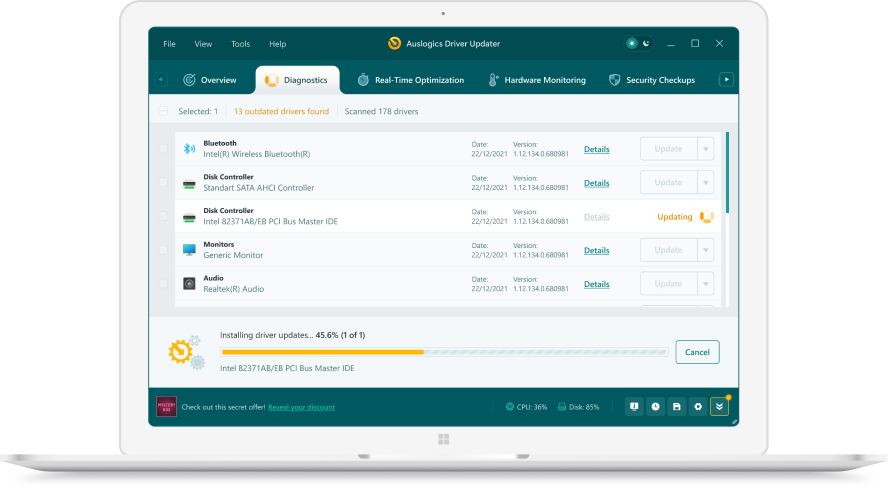 1. Scan. Download the free version and run a scan.
 2. Review. See each old or missing driver with its newer version.
 3. Update. Update one driver free, or all at once with Pro.

Update this driver automatically
Finds and updates this driver and every other outdated driver on your PC.
Auslogics Driver Updater · Free scan · Windows 11, 10, 8, 7 · Backup before every change
What does CLOCK_WATCHDOG_TIMEOUT mean?
On a PC with more than one processor core, Windows expects each core to handle regular clock interrupts. Microsoft’s reference says 0x101 appears when an expected clock interrupt on a secondary processor was not received within the allowed interval. In plain terms, one core stopped responding. Microsoft gives the cause as a processor that is nonresponsive or deadlocked.
The parameters back this up. Parameter 1 is the timeout interval in clock ticks, parameter 3 is the address of the control block of the stuck processor, and parameter 4 is the index of the hung processor. No driver file is part of the code itself, which is why the stop screen often shows no .sys name.
Why this one is honestly often not a driver
Most stop codes on this site trace back to a driver. This one is different. Because a whole core has stopped, the usual suspects are the things that keep a core running: clock speed, voltage, temperature, microcode and the board firmware. An overclock that seems fine in daily use is a classic trigger. So is a BIOS that predates fixes for your processor.
When to look at drivers
If the crashes continue at default settings with a current BIOS and normal temperatures, check the System log in Event Viewer for errors just before each crash. A storage, network or graphics driver that hangs a core can cause the same stop. Update those through Windows Update and your PC maker, then contact the maker if 0x101 still returns.
Questions
Is CLOCK_WATCHDOG_TIMEOUT hardware or a driver?
More often the processor side: overclocking, an old BIOS, overheating or a failing CPU or board. A driver can cause it by locking up a core, so update drivers too, but start with clocks and the BIOS.
Does it mean my CPU is dying?
Not by itself. Microsoft only says the named processor was not processing interrupts, typically because it was nonresponsive or deadlocked. Settings and firmware fix many cases. Repeated crashes at stock settings with current BIOS point to hardware.
Why does it happen in games or heavy work?
Load raises power draw and heat on every core. An unstable overclock or weak cooling often holds up at idle and fails only under that load.
Is it different on Windows 11?
No. The bug check and its meaning are the same on Windows 10 and Windows 11. Only the screen color differs on Windows 11 version 24H2 and later, where it is black.