Fix Memory Management Blue Screen
The MEMORY_MANAGEMENT blue screen (bug check 0x0000001A) means Windows found a severe memory management error. Run Windows Memory Diagnostic first, then set RAM back to default speed and test one stick at a time. If memory passes, update drivers and the BIOS. Microsoft's bug check 0x1A reference recommends the memory test.
Checked November 3, 2026 against the manufacturer's own pages.
The short version
What to install and where it comes from. Every link goes to the manufacturer or Microsoft, never to a copy.
Official files only, nothing bundled
Step by step
Run Windows Memory Diagnostic
Press Windows + R, type mdsched.exe and press Enter, or search Windows Memory Diagnostic in Start. Choose Restart now and check for problems. Save your work first, because the PC restarts straight away.
Read the result
After the test, Windows starts normally. Open Event Viewer, Windows Logs, System, and find the event from MemoryDiagnostics-Results. It says whether errors were found.
Return RAM to default speed
In UEFI setup, turn off XMP, EXPO or any manual memory timings and save. Memory run above its rated default can pass light use and still corrupt data under load.
Test one module at a time
Shut down, unplug the power, and leave a single RAM stick in the slot the board maker recommends. Use the PC for a day or rerun the test, then swap sticks. A stick that fails alone should be replaced.
Update drivers and the BIOS
If memory passes, the cause is likely software. Install Windows Update including Optional updates, then the BIOS and drivers for your model from the PC maker. Pay attention to any .sys file named on the stop screen.
Check the disk
Some 0x1A values involve the page file, which lives on your system drive. Run chkdsk /f /r from an administrator Command Prompt and accept the scan at the next restart.
Faster option: update drivers automatically
The steps above fix this one device. If several drivers are old, a driver updater finds and installs them all in one go, and backs up the current ones first.
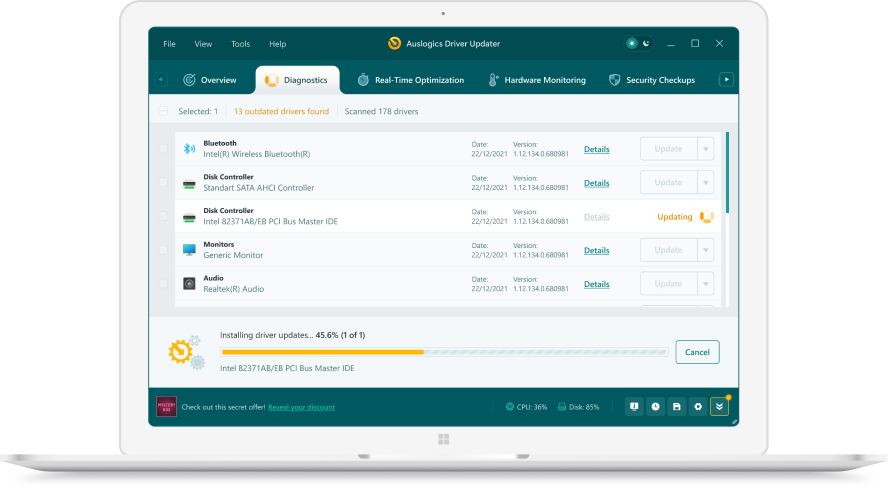 1. Scan. Download the free version and run a scan.
 2. Review. See each old or missing driver with its newer version.
 3. Update. Update one driver free, or all at once with Pro.

Update this driver automatically
Finds and updates this driver and every other outdated driver on your PC.
Auslogics Driver Updater · Free scan · Windows 11, 10, 8, 7 · Backup before every change
What does the MEMORY_MANAGEMENT stop code mean?
Windows keeps careful records of every page of memory: which process owns it, whether it is in RAM or in the page file, and whether it is locked. Bug check 0x1A means those records were found broken, which Microsoft calls a severe memory management error. Parameter 1 says exactly what broke, and Microsoft’s reference lists dozens of values.
You do not need to decode them all. A few tell you which way to look:
| Parameter 1 | Microsoft’s description | Points to |
|---|---|---|
| 0x31 | Image relocation table or code stream corrupted | Probably hardware |
| 0x403 | Page table and page frame numbers out of sync | Probably hardware |
| 0x41790 | A page table page has been corrupted | Memory corruption |
| 0x1233 | A driver mapped a physical page that was not locked | Driver bug |
| 0x4477 | A driver wrote to an unallocated address | Driver bug |
How to find parameter 1
The stop screen shows only the name. After restarting, open Event Viewer, Windows Logs, System and look for the bug check event at the crash time; it lists the four parameters. The small dump file in C:\Windows\Minidump holds them too.
Which drivers are commonly involved?
When a driver is at fault, the file named is often one that handles large blocks of memory: graphics drivers such as nvlddmkm.sys or amdkmdag.sys, storage drivers, and antivirus filter drivers. Update those from Windows Update or your PC maker. If one keeps reappearing after the RAM has passed, Microsoft’s Driver Verifier, started by typing verifier at a command prompt, can stress that one driver. Verify only a few drivers at a time, as Microsoft advises.
Questions
Does MEMORY_MANAGEMENT always mean bad RAM?
No. Microsoft's table includes values that it says probably point to hardware, and others caused by driver bugs, such as a driver mapping a memory page that was not locked. Test RAM first because it is quick, then look at drivers.
Is the memory management error hardware or a driver?
Either. Microsoft flags some parameter 1 values, such as 0x31 and 0x403, as probably hardware errors. Values like 0x1233 and 0x4477 describe a driver doing something illegal.
Windows Memory Diagnostic found no errors. Is my RAM fine?
It is a good sign, not proof. If the crashes continue, test each stick on its own at default speed. The PC maker's own hardware diagnostics give a second check.
Does it happen on Windows 10 and Windows 11?
Yes, the code is the same, and Microsoft's Windows 11 support page uses MEMORY_MANAGEMENT as an example stop code. Windows Memory Diagnostic is built into both versions.