System Thread Exception Fix
SYSTEM_THREAD_EXCEPTION_NOT_HANDLED (bug check 0x0000007E) means a system thread raised an exception that the error handler did not catch, usually inside a driver. Disable, roll back or update the driver named on the stop screen, often a graphics or network file, then check for ACPI and BIOS updates. Microsoft's bug check 0x7E reference gives these steps.
Checked November 3, 2026 against the manufacturer's own pages.
The short version
What to install and where it comes from. Every link goes to the manufacturer or Microsoft, never to a copy.
Official files only, nothing bundled
Step by step
Read the module name
This code often appears with a file name such as nvlddmkm.sys or igdkmd64.sys underneath. The file tells you which device driver to deal with. Photograph the screen if it restarts quickly.
Boot to Safe Mode if it crashes at startup
If the PC fails to start several times, the recovery menu appears. Pick Troubleshoot, Advanced options, Startup Settings, Restart, then press 4. Safe Mode uses basic display and storage drivers, so a bad graphics driver cannot load.
Roll back or remove the driver
Open Device Manager and expand the category the file belongs to, such as Display adapters. Open the device, choose the Driver tab, then Roll Back Driver. If that is greyed out, choose Uninstall device and restart.
Install a clean, current driver
Let Windows Update install a driver, or get one from your PC maker's support page. For graphics, the NVIDIA installer offers Perform a clean installation and AMD Software offers a factory reset, both documented by those makers.
Check ACPI and BIOS updates
Microsoft says to ask your hardware vendor for ACPI or other firmware updates. Get the newest BIOS for your exact model from the PC maker and install it as instructed.
Confirm new hardware is supported
If a new card or adapter arrived before the error, check that its maker supports your version of Windows. Run the PC maker's hardware diagnostics if the error persists after the driver changes.
Faster option: update drivers automatically
The steps above fix this one device. If several drivers are old, a driver updater finds and installs them all in one go, and backs up the current ones first.
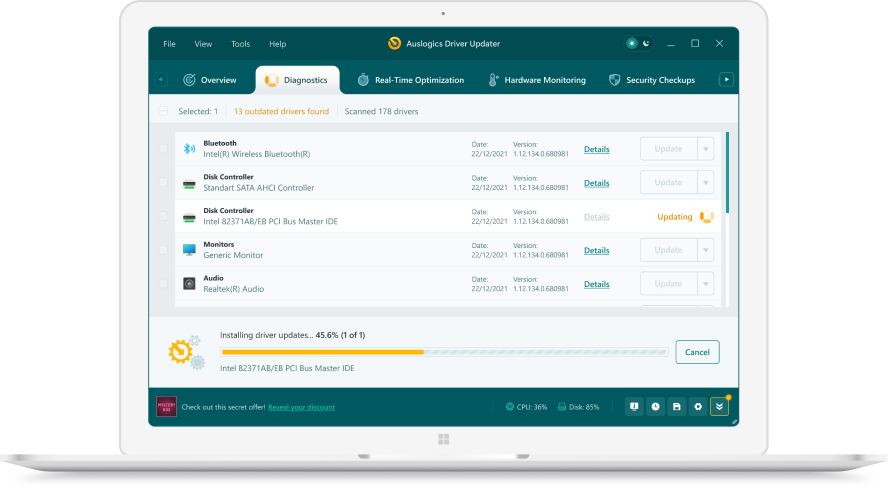 1. Scan. Download the free version and run a scan.
 2. Review. See each old or missing driver with its newer version.
 3. Update. Update one driver free, or all at once with Pro.

Update this driver automatically
Finds and updates this driver and every other outdated driver on your PC.
Auslogics Driver Updater · Free scan · Windows 11, 10, 8, 7 · Backup before every change
What does SYSTEM_THREAD_EXCEPTION_NOT_HANDLED mean?
Windows runs background work in system threads, and drivers create many of them. Microsoft’s definition of 0x7E is that a system thread generated an exception the error handler did not catch. The first parameter is the exception code; the second is the address where it happened. That address is what a debugger uses to name the faulty driver.
Microsoft lists the same three common exception codes it gives for other exception crashes. 0xC0000005 is an access violation, a driver reading or writing memory it does not own. 0x80000003 is a breakpoint hit with no debugger attached, and Microsoft says that should be rare. 0x80000002 means misaligned data.
Which driver file is named in the error?
| File named | Driver for | Where to get the update |
|---|---|---|
| nvlddmkm.sys | NVIDIA GeForce or RTX graphics | PC maker, then nvidia.com |
| amdkmdag.sys or atikmpag.sys | AMD Radeon graphics | PC maker, then amd.com |
| igdkmd64.sys | Intel graphics | PC maker, then intel.com |
| A Wi-Fi or Ethernet .sys file | Network adapter | PC maker, then the chip maker |
Graphics drivers are the most frequent names because they run constantly in kernel mode. Search the file name in Device Manager by opening a device, choosing Driver Details on the Driver tab, and comparing the listed files.
Windows 10 and Windows 11 differences
Nothing changes in the cause or fix. Safe Mode works the same way on both. On Windows 11 version 24H2 and later the stop screen is black rather than blue, and on Windows 10 the recovery path from inside Windows is Settings, Update & Security, Recovery.
Questions
Is SYSTEM_THREAD_EXCEPTION_NOT_HANDLED hardware or a driver?
Mostly a driver, since the crash happens inside a system thread a driver runs. Microsoft also lists system incompatibilities, memory conflicts and IRQ conflicts, so firmware and hardware are worth checking if a new driver does not help.
How is it different from KMODE_EXCEPTION_NOT_HANDLED?
Both are uncaught exceptions in kernel code. 0x7E is specific to a system thread, and its parameters 3 and 4 point to the exception and context records. The fixes are almost the same.
What if the screen says ntoskrnl.exe or ntkrnlmp.exe?
Those are the Windows kernel. Microsoft describes extra dump analysis steps for when the debugger blames ntkrnlmp.exe, because the kernel is often only reporting a fault that started in a driver.
Does it happen after Windows 11 upgrades?
It can, when an older graphics or network driver carried over from Windows 10 does not suit the new build. Install the driver for Windows 11 from your PC maker after upgrading.