Device Descriptor Request Failed
Device Descriptor Request Failed means Windows asked a USB device to identify itself and got no usable reply, so it lists it as Unknown USB Device. Move the device to a rear port with a known data cable and no hub, then reinstall the USB controllers in Device Manager and install your PC maker's chipset driver.
Checked November 3, 2026 against the manufacturer's own pages.
The short version
What to install and where it comes from. Every link goes to the manufacturer or Microsoft, never to a copy.
Official files only, nothing bundled
Step by step
Change port, cable and hub
Unplug the device, then connect it to a port on the back of a desktop or directly on the laptop. Take out any hub, dock, extension or front panel lead. Use a cable you know carries data, since charge-only cables give power but no descriptor.
Power the PC down fully
Shut down, unplug the power cord for a minute on a desktop, then start again with the device disconnected. Plug it in once Windows has loaded. This lets the USB controller start from a clean state.
Remove the unknown entry and rescan
In Device Manager expand Universal Serial Bus controllers, right-click the Unknown USB Device entry and pick Uninstall device. Then select Action, Scan for hardware changes with the device still connected.
Reinstall the USB host controllers
Still under Universal Serial Bus controllers, uninstall each USB Root Hub and each host controller entry, then restart. Windows puts them back automatically. Your mouse and keyboard may stop until the restart, so do this last in the session.
Test with USB power saving off
Open Control Panel, Power Options, Change plan settings, Change advanced power settings, USB settings, and set USB selective suspend setting to Disabled. Reconnect the device. Microsoft's driver documentation says this feature is on by default and recommends keeping it on, so switch it back if this test changes nothing.
Install the chipset driver
Get the chipset driver for your exact PC or motherboard model from its maker, or from Intel or AMD for a self-built desktop. Check Settings, Windows Update, Advanced options, Optional updates too, then restart.
Faster option: update drivers automatically
The steps above fix this one device. If several drivers are old, a driver updater finds and installs them all in one go, and backs up the current ones first.
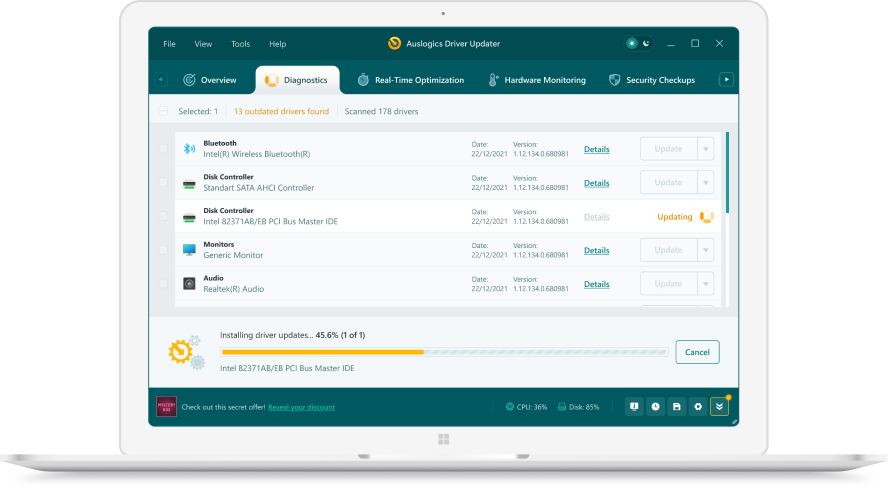 1. Scan. Download the free version and run a scan.
 2. Review. See each old or missing driver with its newer version.
 3. Update. Update one driver free, or all at once with Pro.

Update this driver automatically
Finds and updates this driver and every other outdated driver on your PC.
Auslogics Driver Updater · Free scan · Windows 11, 10, 8, 7 · Backup before every change
What does Device Descriptor Request Failed mean?
When you plug in a USB device, Windows resets the port and then sends a GET DESCRIPTOR request. The device must answer with its device descriptor. Microsoft’s USB documentation explains that Windows builds the device’s hardware ID from two fields in that reply, idVendor and idProduct. Device Manager shows those IDs in Properties, Details, Hardware Ids for a working device.
If the reply never arrives, or arrives garbled, Windows has no vendor or product to match. It cannot load the right driver, so it shows Unknown USB Device (Device Descriptor Request Failed) and usually reports Code 43. The cause sits somewhere between the device’s chip and the PC’s USB controller.
How to tell a bad device from a bad PC
| Test | Result | What it points to |
|---|---|---|
| Device on another PC | Same error | The device or its cable |
| Another device on this port | Also fails | The port, controller or chipset driver |
| Device on a rear port, no hub | Works | Front panel, hub or power shortfall |
| Works after restart, fails after sleep | Comes and goes | USB power saving |
When the USB device is the problem
A device that fails on every PC and with every cable is usually faulty. Phones and some development boards also show this error when they boot into a mode that does not answer correctly. Check the maker’s support site for that device before replacing it.
Questions
What is a USB device descriptor?
It is a short block of data every USB device must send when it is plugged in. It tells Windows the vendor ID, the product ID, the USB version it follows and how many configurations it has. Windows turns the vendor and product IDs into the hardware ID it uses to find a driver.
What is the difference between Device Descriptor Request Failed and Port Reset Failed?
Both mean Windows could not finish setting up the device after it was plugged in, so it never learned what the device is. Port Reset Failed names an earlier stage of that setup. The fixes are the same: cable, port, power, then controller and chipset drivers.
Will a driver for the device itself fix it?
Rarely. Windows cannot pick the device's own driver until it has read the descriptor, because the hardware ID comes from it. That is why the connection, power and USB controller come first.
Does this happen on Windows 11 more than Windows 10?
No. The message and the causes are the same on both. The steps on this page work on Windows 10 and Windows 11.