Update chipset drivers
To update chipset drivers, download the chipset package for your exact board or PC model from the motherboard or PC maker, or use AMD's drivers page (Chipsets, socket, chipset) or Intel Chipset Device Software. The processor itself needs no separate driver download: Windows already includes what the CPU needs, and the chipset package handles the board around it.
Checked November 3, 2026 against the manufacturer's own pages.
The short version
What to install and where it comes from. Every link goes to the manufacturer or Microsoft, never to a copy.
Official files only, nothing bundled
Step by step
Find out who made your processor and board
Press Windows + R, type msinfo32 and press Enter. Processor shows AMD or Intel. BaseBoard Manufacturer and BaseBoard Product name the motherboard, for example a B650 or Z790 board.
Laptop or prebuilt PC: use the maker's page
Enter the model or serial number on the PC maker's support site and open the Chipset category. Install every item there in the order the maker lists, then restart.
Self-built AMD PC
On AMD's drivers page choose Chipsets, then the socket (AM5 or AM4), then the chipset. The motherboard maker's support page for your board is an equally safe source.
Self-built Intel PC
Use the motherboard maker's chipset download, or Intel Chipset Device Software. Intel says pre-built systems and third-party boards should get updates from the maker.
Check System devices after the restart
Open Device Manager, expand System devices and look for warning triangles. Unknown entries under Other devices that disappear after the install were waiting for chipset INF files.
Faster option: update drivers automatically
The steps above fix this one device. If several drivers are old, a driver updater finds and installs them all in one go, and backs up the current ones first.
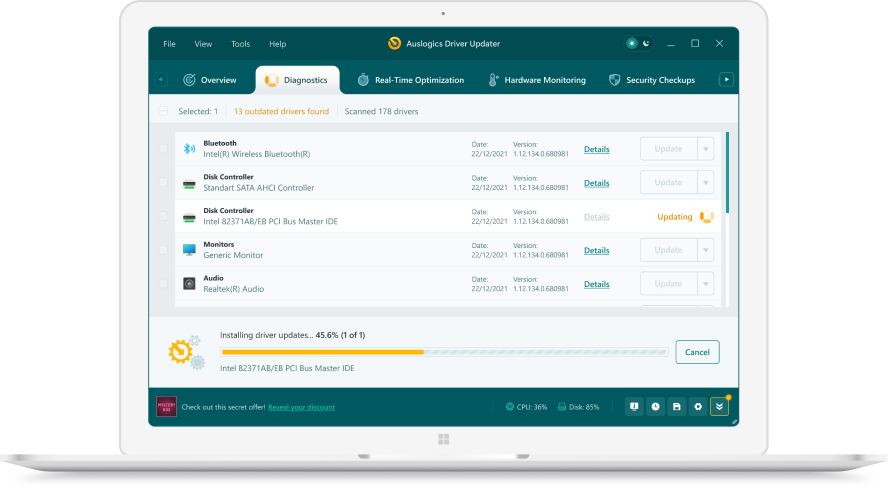 1. Scan. Download the free version and run a scan.
 2. Review. See each old or missing driver with its newer version.
 3. Update. Update one driver free, or all at once with Pro.

Update this driver automatically
Finds and updates this driver and every other outdated driver on your PC.
Auslogics Driver Updater · Free scan · Windows 11, 10, 8, 7 · Backup before every change
What is the difference between CPU, chipset and motherboard drivers?
People use the three terms as if they meant one thing. They do not. The CPU runs your programs and is handled by Windows itself. The chipset is the set of controllers that links the CPU to USB ports, storage, PCI Express slots and the system management bus. The motherboard carries the chipset plus extra chips from other makers: a network controller, an audio codec, sometimes a Wi-Fi card. A motherboard driver update is really a set of separate downloads, and the chipset one is only the first.
What does each chipset package actually install?
| Package | What Intel or AMD say it does |
|---|---|
| Intel Chipset Device Software | Installs INF files so Windows can identify chipset components |
| AMD Chipset Drivers | Platform drivers for the board plus Ryzen power plans |
Intel describes its utility as a way to make sure Windows INF files are installed for device identification, which removes yellow bangs in Device Manager. It does not replace graphics, USB 3.0 or network drivers, which Intel lists as separate items.
When should I also update the BIOS?
Only when the maker lists a fix you need: support for a newer processor, a security update, or a stability note that matches your problem. A BIOS update is not a driver. Follow the board maker’s own instructions, keep the PC on mains power, and do not start it on a low laptop battery.
Questions
Do CPUs need drivers?
Not as a download. Windows ships with the code needed to run AMD and Intel processors, and Device Manager lists each logical processor under Processors with a driver from Microsoft. What you update is the chipset package and, rarely, the BIOS.
How do I update my CPU drivers then?
Install the chipset package from the board or PC maker, keep Windows updated, and apply BIOS updates the maker publishes for your board. Those three cover what people mean by CPU drivers.
How do I update motherboard drivers?
Open your board's page on the maker's site, choose your Windows version, and install chipset first, then LAN, audio and other items. Each component has its own package.
Will a chipset update make my PC faster?
Usually not in any way you would notice. It names unknown devices, adds power settings on AMD systems, and fixes bugs. Do not expect higher frame rates.