Fix No Audio Output Device
No Audio Output Device is installed means Windows cannot find a working sound device, usually because the audio driver is missing, disabled or failed to load after an update. In Device Manager, enable the device under Sound, video and game controllers, or use View, Show hidden devices and Action, Scan for hardware changes. Then install the audio driver from your PC maker, as Microsoft advises.
Checked November 3, 2026 against the manufacturer's own pages.
The short version
What to install and where it comes from. Every link goes to the manufacturer or Microsoft, never to a copy.
Official files only, nothing bundled
Step by step
Restart properly
Select Start, Power, Restart rather than shutting down. A restart reloads drivers fully and sometimes brings the device back on its own.
Enable the audio device
Open Device Manager and expand Sound, video and game controllers. If your audio device is listed with a down arrow, right-click it and choose Enable device.
Show hidden devices and rescan
If nothing is listed, choose View, Show hidden devices, then Action, Scan for hardware changes. Windows tries to detect and load the sound hardware again.
Check the Intel SST controller
On many Intel laptops, expand System devices and look for Intel Smart Sound Technology. A yellow mark or Code 10 there blocks every speaker and mic, so fix it before the Realtek or other codec driver.
Install the PC maker's audio driver
Go to your laptop or motherboard maker's support page, enter the model and install the audio driver for your Windows version. On SST laptops, install the maker's SST package too. Restart.
Run the Audio troubleshooter
Open the Get Help app and run the Audio troubleshooter. It checks the device and the Windows Audio services.
Faster option: update drivers automatically
The steps above fix this one device. If several drivers are old, a driver updater finds and installs them all in one go, and backs up the current ones first.
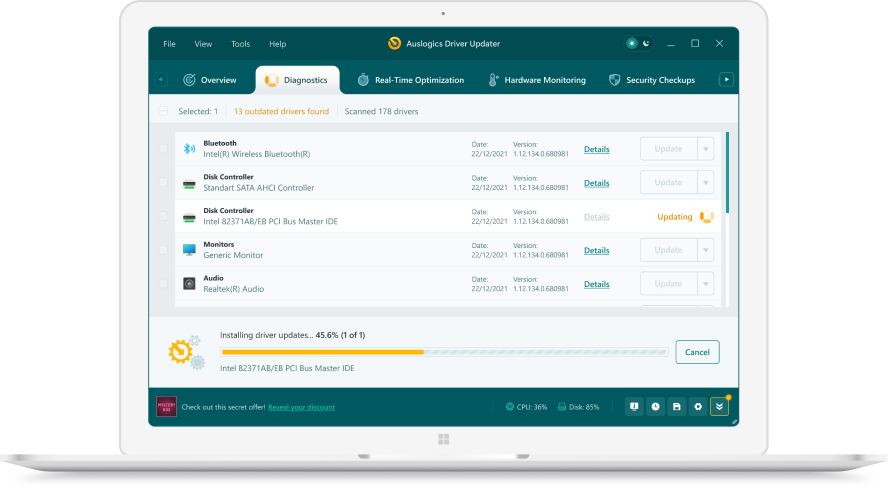 1. Scan. Download the free version and run a scan.
 2. Review. See each old or missing driver with its newer version.
 3. Update. Update one driver free, or all at once with Pro.

Update this driver automatically
Finds and updates this driver and every other outdated driver on your PC.
Auslogics Driver Updater · Free scan · Windows 11, 10, 8, 7 · Backup before every change
What does No Audio Output Device is installed mean?
The message comes from the speaker icon on the taskbar. It means Windows has no playback endpoint at all, not that the volume is off or the wrong speaker is picked. Microsoft says the sound settings may also look grayed out, and speakers or headphones are missing under Output. That points at the driver layer. Changing the default device will not help until a device exists again.
Intel Smart Sound Technology on Intel laptops
On many recent Intel laptops, the speakers and mics sit behind an Intel Smart Sound Technology (SST) audio controller. The codec driver, often Realtek, depends on it. If the SST controller fails with Code 10, Windows can lose every audio output at once. Intel says SST drivers come from the PC maker, and its Code 10 guide suggests checking the BIOS version, uninstalling the SST device and restarting, then installing the maker’s driver.
| What you see in Device Manager | Likely meaning | What to install |
|---|---|---|
| Nothing under Sound, video and game controllers | Driver missing or device hidden | PC maker’s audio package |
| Device with a down arrow | Device disabled | Nothing, choose Enable device |
| Intel SST with Code 10 | Audio controller driver failed | PC maker’s SST package, then codec driver |
| Intel Display Audio with a warning | Graphics package audio failed | PC maker’s or Intel’s graphics driver |
Audio services
Windows plays sound through the Windows Audio and Windows Audio Endpoint Builder services. Open Services from the taskbar search and check both show Running with Automatic startup. If either is stopped, start it and test again.
Questions
Why did this start after a Windows update?
Microsoft lists a Windows update or a driver change as common triggers. The update may install a driver that does not suit your hardware. Reinstalling the PC maker's audio driver usually fixes it.
Is my sound card broken?
Rarely. If the BIOS still lists onboard audio and the device shows up under Show hidden devices, the hardware is present. A missing or disabled driver is far more common.
What does Intel say about this error?
Intel says to check with your computer maker first, since Intel audio drivers for display audio ship with the graphics driver. If Intel Display Audio or Intel High Definition Audio has a warning, uninstall it and restart.
Does the fix differ on Windows 10?
No. Microsoft gives the same Device Manager steps and the same Get Help troubleshooter for Windows 10 and Windows 11.